
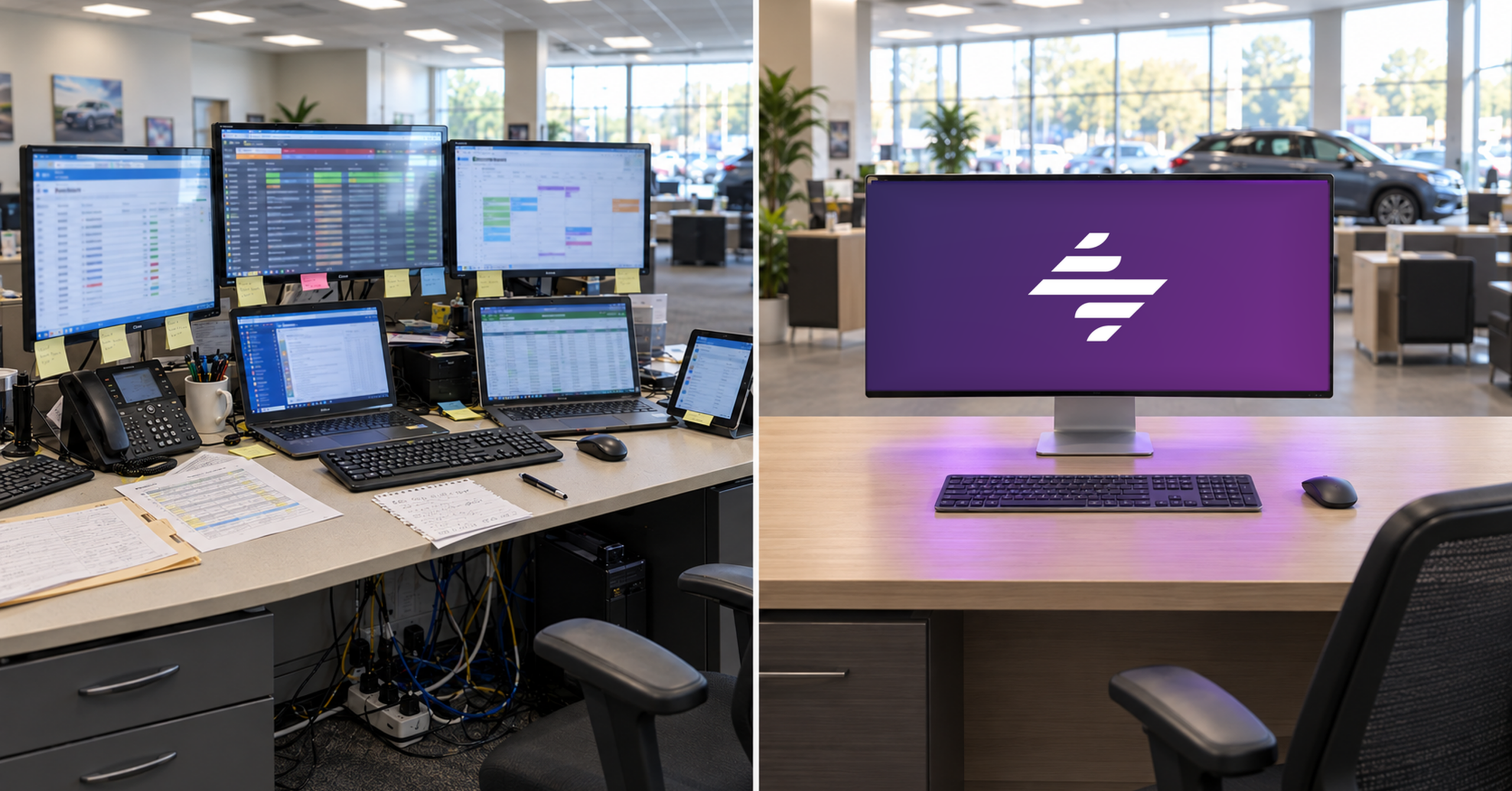
Franchise retail’s real threat isn’t the direct-sales model. It’s the Frankenstack dealers built themselves, one reasonable purchase at a time, and the customer is the one paying for it.
By Earl Brown, Solera Dealer Solutions
She entered her trade on your website. She repeated it to the BDC agent who called an hour later. She said it again to the salesperson who walked out to meet her, who wrote it on a scrap of paper. Then she watched a finance manager type it a fourth time.
She is not thinking about your integrations. She is thinking that this is harder than it needs to be. And somewhere in that fourth retelling, a factory-direct website stops sounding like a compromise and starts sounding like a mercy.
That is the threat to the franchise model, and it did not arrive from a D2C EV manufacturer. It came out of your own file cabinet, in the form of twenty signed agreements.
The advantage nobody wants to name
The industry has spent a decade arguing about direct sales as a legal question. Franchise law, licensing fights, the occasional court win. But D2C’s real advantage was never statutory, and it was never the price. It was the length of the transaction.
Direct sellers win by being easier and more efficient. One system, one record, one path, no re-asking. That is the entire proposition, and it is devastating precisely because it is boring. Nobody buys direct because they admire the software. They buy direct because they only had to say things once.
Now ask what made retail long.
The Frankenstack was assembled by consensus
Every piece of it probably started as a good decision in isolation. A tool for photos. A tool for texting. A tool for equity mining. A tool for scheduling. A tool for digital retailing, then a second one because the first didn’t talk to the desk. Each solved a real problem the week it was bought, and each arrived with its own login, its own database, and its own version of your customer.
A recent dealer technology study found stores running 20 or more systems, often with overlapping functions, and identified integration difficulty and underutilization as the top recurring complaints.
Nobody designed that. It just accumulated. There was no architect, no plan, and no single person accountable, because no vendor’s contract has ever covered the whole customer experience. What holds it together is duct tape, and the duct tape is your employees.
The four taxes already on your P&L
The time tax. One industry study found dealership employees switching between applications nearly 1,200 times per day, losing as much as four hours every week, the equivalent of 32 days a year, with 94% of dealers acknowledging significant operational inefficiency. You are not paying people to sell cars. You are paying a meaningful percentage of payroll for retyping.
The overlap tax. Go down your accrual schedule and count how many tools text a customer. Then count how many score a lead or send a service reminder. Every vendor in this business grew into every other vendor’s category after you signed, so you now pay two and three times for the same capability and call it a technology budget.
The reconciliation tax. The first twenty minutes of the Monday manager meeting go to arguing about whose report is right. Four systems, four versions of the truth, no decision. Leadership isn’t managing the store, it’s refereeing the software.
The customer tax. This one never appears on a financial statement, and it is by far the largest. In an October 2025 survey of 600 U.S. dealerships, 81% said they lose customer conversations or leads because their CRM, chat and inventory systems fail to communicate, and 65% said follow-ups get delayed for the same reason. At the same time, only about 69% of shoppers describe buying a car as easy, and that figure has been trending down.
The first three taxes cost you money. The fourth one costs you the business, because it does not show up as an expense. It shows up as a customer who decides the retail model itself is the problem.
Friction used to be affordable
For most of the last decade, fat front-end gross paid for all of this and waste was survivable. That era has closed. Gross is normalizing, expenses are not, and the stack invoices on the first of the month regardless of how the month went. You are paying more to sell the same car, and your customer is enjoying it less than they did five years ago.
There is a fragility argument too, and it deserves more attention than it gets. When one DMS provider went dark for three weeks in June 2024, franchised dealers lost an estimated $1.02 billion and roughly 56,200 new vehicle sales. An architecture nobody designed is also an architecture nobody stress-tested. Twenty vendors is not redundancy. It is twenty ways to hit the wall.
The question that has no good answer
Who at your store owns the customer experience end to end?
Not the GM, who owns the numbers. Not the GSM, who owns the floor. Not the fixed ops director, who owns the lane. Not the person who administers the CRM, who owns a screen. And not one vendor on your accrual schedule, because none of them ever agreed to.
At most stores the honest answer is nobody. The customer is the only person who experiences your dealership as one continuous thing, and she is the only participant with no system, no dashboard, and no advocate. Every re-ask is a small, free advertisement for buying around you.
What a real operating system changes
The fix is not another tool, and it is definitely not AI layered on top of the same fragmentation. Intelligence bolted onto a Frankenstack only scales the inefficiency.
The alternative is architectural: one platform that runs the store front to back, where sales, service, finance, marketing, inventory, titling and the connected vehicle after delivery all write to the same customer record and feed the same engine.
What that looks like on the floor is quieter than any demo. The customer stops repeating herself, because the store already knows. The salesperson stops alt-tabbing, because the answer is on the screen he already has open. Managers stop reconciling reports and decide off one number. Your people stop being the integration layer and go back to selling cars and fixing them.
And the economics invert. In a Frankenstack, every addition adds cost and complexity. In an operating system, every addition makes what you already own smarter. Service history sharpens equity. Equity sharpens marketing. Marketing sharpens what you stock. The platform you run next quarter is worth more than the one you run today, with no re-implementation.
That is the whole argument for the franchise model. You have the trade, the service history, the technicians, the local relationship, and the record of everything that customer has ever done with you. No factory has that. But an advantage scattered across twenty systems isn’t an advantage, it’s an archive.
Duct-tape retail technology had a good run. It will not survive customers who have already been shown what short looks like.
Count your logins. Then decide whether your store is running a platform or paying rent on a pile.